Showing posts with label chickens. Show all posts

Wednesday, November 13, 2013

All Cooped Up

If you aren't familiar, there is an entire rearing period for raising chickens. Those sweet, fluffy, chirping little darlings that come through metered mail can't go hanging out in the frosty mornings and brisk afternoons of April in the Inland Northwest. We chose 3 Deleware's and 2 Speckled Sussex's for our first flock.

Really, it isn't until they are around 9 weeks old that they have enough feathers, and the weather is warm enough, for the fledglings to cope with the real world, and boy-o, it doesn't come fast enough!
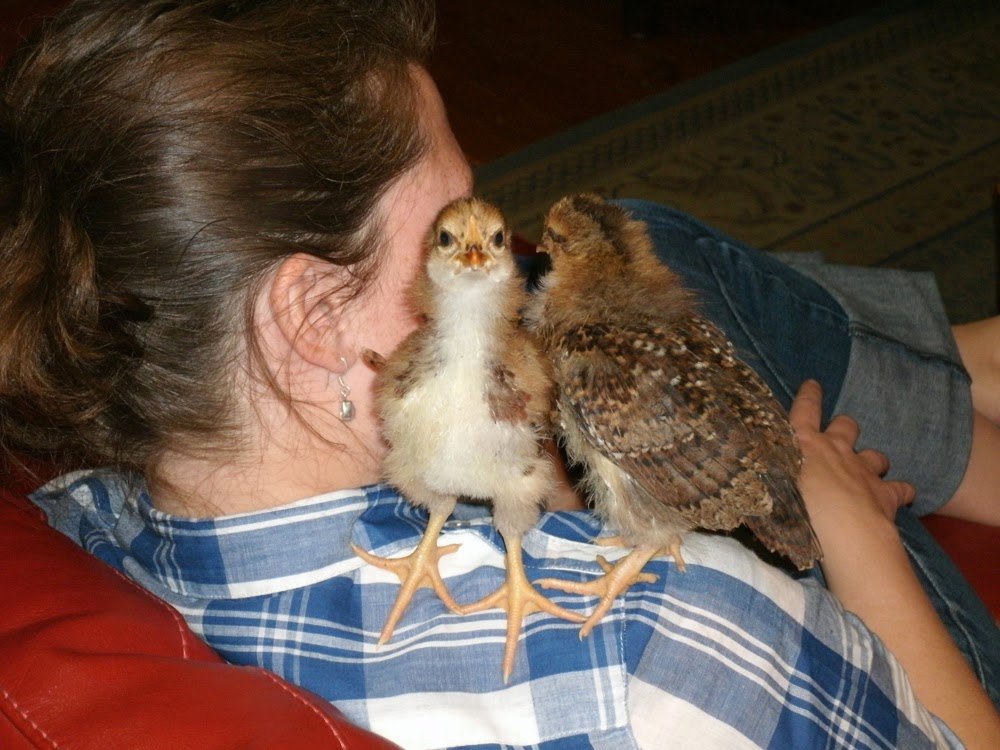
The fluffy little fluff-puffs are pretty darned cute, until you hear their sad chirping of loneliness, or even worse, symptoms of pastey-butt. Pastey-butt, as I've learned to call it, is a terrible chick ailment where their poor fluffy bottoms get, well, pastey and clogged. Look it up. At any rate, it can be a deadly condition if not managed well, and really stressful to see these little babies sick. I was fortunate not to lose any of my chicks to this, but I certainly did my time of cleaning and caring. And by-gum, we made it!

We did our research and read about handling our new layers to help them become accustomed to us, and also to accustomize our dogs to them. We have two big-ish dogs, if you haven't tuned in. One is a German Shepard/boxer, the other a plott hound/boxer. Neither of them are good with cats, which led us to be concerned with chickens. Let's be honest, chickens are food animals. If cats look like food to our dogs... well... We worked pretty hard to establish that acknowledgement and overcome it. I remember there being a few moments in history where my personal confidence of my canines' relationship with our chickens was much higher than those of others. Call it foreboding. Call it a mother's love.

By week 4-6, baby chicks aren't as baby or sweet and cuddly anymore. They are kind of in that same world we were in during junior high, with our braces, first pair of glasses, and awkward haircuts. These 'chicks' (really though, let's call them what they are, Pullets, by now) are stinky, ugly, noisy, and really good at jumping out of the big rubber-maid container I call a brooder. I'd like to say I've made it through this phase and won't look back, but let's be realistic, chickens don't have an 18 year weening period. It'll happen again.

The SketchUp version.
I'm sure it was around this time that I started to get really enthusiastically serious (I'm sure John helped motivate) about setting up a chicken coop. We couldn't get it ready fast enough! Sure, I'd been planning it using Chief Architect, and conversely John and been planning it using SketchUp, as he is prone to do. I'm pretty sure mine came out better.

My goal was to build a chicken coop very cheaply, to buy the least amount of material possible, to use our various accumulation of skills and experience to make it happen. Was I successful? I'm not sure. I've read of people who have created coops for much less than we did (I think in the end, we spent over $150). I'm not sure if this means we aren't resourceful enough, we don't hoard enough, or if it just costs more that I would expect. I guess it is what is it is. I did get to be lead carpenter, laminate guy, roofing installer, and finish carpenter on this project though. I liked that.

We had some of the 2x framing materials on hand, but still needed to buy a few sticks for the roof and nesting box, I think. The most expensive components for us were the 4 concrete footings that we used for setting the floor framing. We also needed to buy the Pressure Treated lumber used for the floor framing of the coop. We wanted the coop to be easy to clean, so we used some leftover EPDM from the pond liner for the flooring, then found a remnant of laminate from a flooring center for the wall linings. We had rigid foam insulation left over from other projects, lap cedar siding from the house, asphalt roofing, and OSB for the doors too, so all that was left was the mesh for the windows/vents.

I'm pretty happy with the way that the coop turned out in general. I think that there is plenty of space [in the coop and nesting area] for 7 chickens (we've only maxed out at 5 so far). The one thing I wish we had done differently is the enclosure/run. If I had designed the coop to sit off the ground at least 24", it would have given me an add'l 10 square feet of enclosure space = free fresh air for chickens.

First night in the new coop.
Once those chickens hit the 9 week mark, we were almost ready to house them in a new coop. I put a red light inside to help offset the winter light and promote laying... in spite of the fact that you can't expect hens to lay their first egg until around the 21st week. Chicken rearing is a good exercise in patience and stewardship.

Have you built a coop of your own? Do you aspire to? How does it turn out?

Counting your Chickens After They Hatch

In the realm of our chicken adventures, I last left off at receiving our chicks via snail-mail.

Since that day, we've had epic failures but also overall success with our flock, which led us to "expanding" it the following spring... sound a bit vague? Probably because there are too many details to cover in an introductory sentence or two.

And away we go.
When our first batch of chicks arrived I was away on a business trip (I believe this was mid-April). This was a complication for obvious reasons, but I'll cover a few of them anyway. First off, the deal between John and I was that the chickens were MY deal, MY responsibility. He didn't want to get stuck doing all the work and worrying about these creatures that I insisted on obtaining... no matter how interesting and productive they were. This was the deal when he agreed that backyard chickening would in-fact occur. I thought it was a fair deal. The guy takes care of a lot around our house, I could understand why he wouldn't want to be saddled with one more thing. Deal.

So it was ON. I placed my order for chicks, and in doing so learned that the heritage breed that I'd been dreaming of (Delawares) were fairly rare, frequently back-ordered, and often unavailable. The only available date that would ensure them to get to our house as spring chickens would be to order them for an arrival date where I would be out of town on a business trip. After many guilty feelings and apologies, I asked John to receive the chicks and was terrified that the tiny little babies would be left on our doorstep in the cold and he would come home from work to find a box of chick-cicles.

My worries were unfounded, as it turned out. Also, my appreciation for the USPS was raised 10-fold. They handled the handling of our package wonderfully and were great about notifying us when the package arrived in not only a friendly but easy manner. John was able to retrieve them without any hassle and nursed them for their first week while I was away.

I didn't get to be there to see our next package of chick opened this year either (we hosted an order for 3 households). On both occasions John has been around to receive the box, for which I am thankful, but I am still intrigued to experience that first moment when you open your long anticipated box of chicks. It might not happen for me any time soon... our coop is full up.

Now, once you have a bunch of new chicks in your house, you are faced with a very real task... how will I house them and keep them safe, healthy, and happy?

Sunday, December 4, 2011

Urban Chickening - I highly recommend these outdoor pests


I came down with chicken fever in the fall of 2009. I don't remember exactly what prompted the obsession (I think it was my disdain for mental images of all of those commercial layers being crammed in tiny coops w/ not hope for daylight and fresh air) but I remember lots of speculation about where a chicken coop would work in our backyard. There was a lot of researching of breeds, and even more chicken coop designing.

It wasn't until last winter, after much wavering, that the decision was made. Forget about the added responsibility, the expense, and the addition of one more project that would require completing. I had to have CHICKENS!

For the first 20 1/2 weeks, I must admit that I regretted the decision immensely. Let's see... I suppose I should begin at the beginning.

I started by trying to convince every one else I knew to get chickens before I did. This plan didn't work so well. I decided that I was just going to do it, then thought about that fact that we already have a ton of loose threads in our lives. Unfinished house projects, unkempt gardens, craft projects 1/2 finished, and who knows what else were adding unnecessary stress to our lives, why would I be so foolish to add 1 more? Chickens require a coop, an enclosure, time, and attention. Firm NO. Nope, I've learned my lessons, I'm NOT going to get chickens. Plus, I thought we were on the verge of getting a friend who lives nearby to make the leap... I would be able to learn about chickens vicariously... but then a terrifying thing happened, they were considering not doing it either! Dear lordy... what about the chickens?!

So, in a snap decision, I changed my mind. We were going to make this happen. I'm glad to report that our friends did too.

I re-researched and found my top-two chicken breeds. I wanted birds that were dual purpose meat birds and layers (in case we decided we weren't chicken farmers after all, and we wanted to make soup instead). I also wanted birds that were known to be quite, gentle, and able to be kept in a small space during days while we were at work. They needed to be cold-hardy, and on top of it all lay as many eggs as chickenly possible. I also knew that there are many chicken breeds on the verge of being lost forever to commercial breeds.

Cindy-Lou, the Deleware
I found websites to research the different endangered heritage breeds and settled on Delewares and Speckled Sussex as my top choices. I became a frequenter of the website BackyardChickens.com, and used their breed index to settle on my choices. They offer quite a lot of useful guides about breed characteristics with their breed index. This site was also invaluable for step-by-step chick rearing, and chicken coop design ideas.

Tinkerbell (a.k.a. "Toeless") a
Speckled Sussex, in the foreground.
I ordered my chicks from MyPetChicken.com, who ships baby chicks in the mail. The idea of this was hard for me to conceive and caused great anxiety. What if another package was place atop my chicks and they were crushed? What if they get turned upside down and sideways and tumbled in their box? Its still cold in April, what if they freeze? Adding to the concern was that fact that I had to leave town for business the day before they were to arrive. With John at work all day, how would the chicks be rescued from their cardboard prison?!

Fortunately, all of my concerns were for naught. John was able to be there when the delivery came, and the all 5 chicks were peeping and relatively happy.

Next up... coping with baby chicks. When is it cute that your dogs show interests in chickens? Do backyard chickens actually lay eggs? And other trials and tribulations...

Deck, Deck, Chicken

Our backyard has an ever-changing landscape. And I don't just mean the seasons. It has gone through many transformations...most of those for utilitarian purposes. I think overall, we've made changes for the better, but holy-moly, has it taken a long time!

Let's see, we moved into the house in December of 2002. Due to the frigid north-Idaho winter temperatures, we didn't focus too much on the backyard (or front yard for that matter) until months later. I'm not sure we even bothered to go back there... it seems like a distant memory.

Here are some of the things I do remember. I do remember a backdoor off the kitchen that went to a "screen-porch" (i.e. un-insulated catch-all room), which had another door to a back stoop. There were concrete steps from that door to a concrete pad. This back-patio area was a slab that sloped toward the house, so with any amount of rain we had puddles of moisture right against the foundation. There was a lean-to roof covering most of the slab. It was made of that green corrugated translucent roofing stuff, and was covered in mildew + 1 dead parakeet.

I also remember that there was no fence worth mentioning... okay it was worth mentioning for the sake of reminiscing. I think there was a scattering of metal fence posts driven in a "row" between our house and the neighbor's with some welded wire fencing strung across. I feel like this acted more like a deterring wad, than any sort of a real barrier. I'm not certain who erected the structure, but thankfully our neighbors were also relatively new to the 'hood, young, and eager to improve... so a nice cedar fence was in our future.

Along the back edge of the yard were 6 or so Spruce Trees. The must have been fairly old, I think that they each were at least 20" in diameter. It wasn't much of a life for those trees, they'd all been topped numerous times for the sake of the electrical lines running 20' overhead. Each tree looked mangled and angry and were weeping pitch and needles and blocking all of the sunlight possible, as though they needed to share their misfortune with whom ever resided inside.

One of our biggest focuses (i.e. obsessions) that winter was to get a dog the next spring. Every person in the neighborhood we spoke with told us horror stories of Parvo and how all of the dogs who lived in that back yard got sick. This was terrifying for us, mostly because we had also learned that the deadly-to-puppies disease lives in the soil and exposure to sunlight is one of the only ways to rid it of your premises, something sorely lacking in our back yard.

So... first order of business as the first leaves began to emerge: dogify the back yard. This included the new fence and the removal of those mean, mean spruce trees, thusly scorching parvo forever from our earth.

Fortunately for this project, the spruce trees were trying to stretch their arms back up into the electrical lines. John called in the artillery by contacting the power company about limb removal. It turns out that the fellows on the limbing crew that day were of a very generous nature. They limbed the spruces all the way to the ground, and that was that.


Additional modifications promptly included a doghouse and a dog. Both of the built-in variety. Simon was an irresistible find from Northwest Seed and Pet, a cool pet and garden establishment nearby. Maggi came that fall, an adoption through a local group that posted her litter on PetFinder.com.

We continued expansion with a raised bed built during a rainstorm, a brick patio in the herringbone pattern, two huge mounds of dirt, a koi pond, a deck, a tool shed, and most recently a chicken coop. Each of these projects deserve a small bit of spotlight of their own... so that might need to be for another day.

Some features were modified to suit our needs as they developed, but I really think that we are on our way to being finished back there, maybe only 1 or 2 more seasons... that is, until I decide to jump on my long growing (since 2006) obsession with honeybees...